Inventory you can trust.Billing you can explain.
FloorStack is the operating system for a small 3PL: multi‑client inventory, orders, shipping labels, a client portal and billing in one system — running a real fulfillment warehouse today. Stock orders and vendor‑direct orders on one order model. Every invoice line traceable to the warehouse event behind it. From $199 a month, $100 off for your first three months, no onboarding fee, no contract.
Bring one month of invoices and one client workflow. We show what was billable, what was missed, and how it runs here. No contract. Answered within an hour, business hours.
7
Events written to the audit log since you opened this page
1,582
Units on hand, five counts per SKU, always balanced
360
Labels bought this month, postage at cost
1,211
Ledger lines billed to seller wallets, $0 reconciled by hand
What you get
01
Inventory that always balances
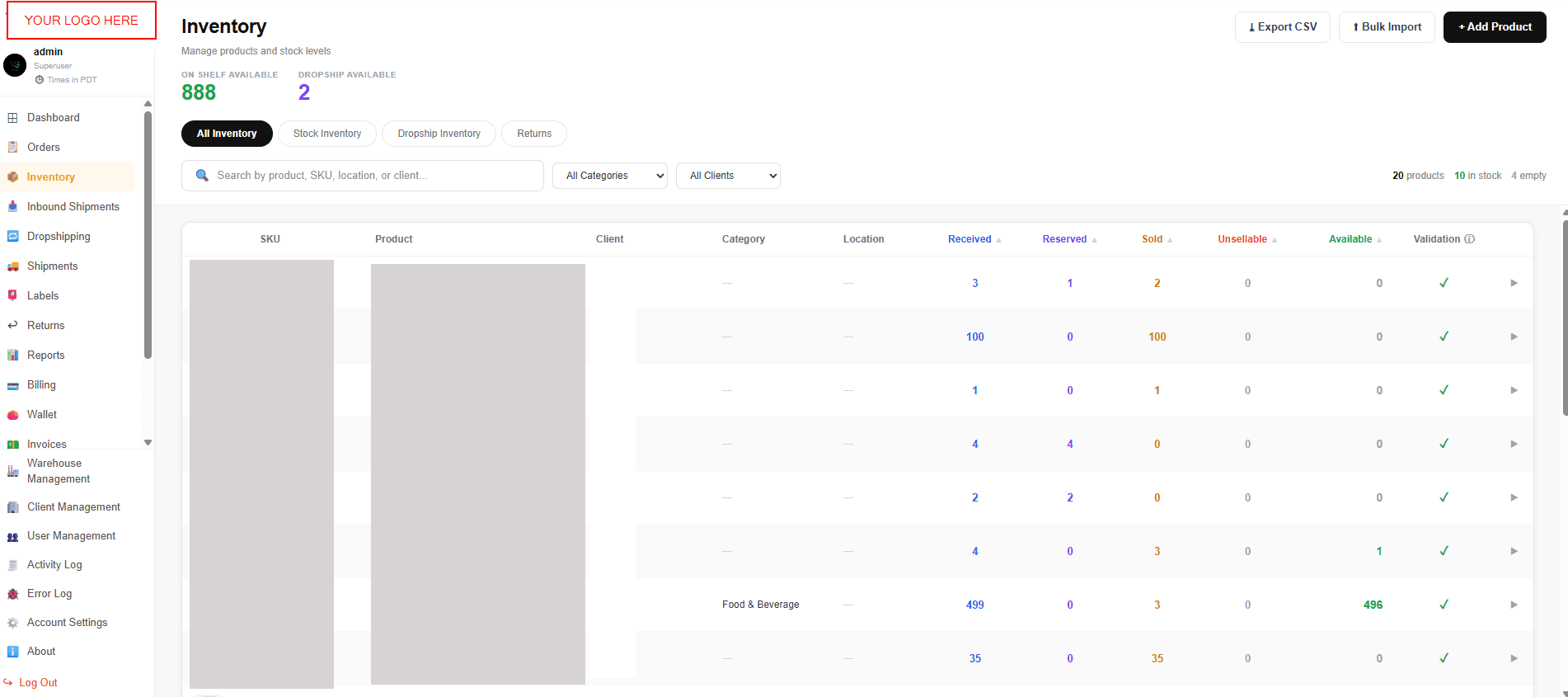
Received = available + reserved + sold + unsellable, per SKU, per client. Enforced in the database, not in a report you run on Friday. A write that would break it is refused and logged — so your count, the client’s portal and the invoice never disagree.
02
Stock orders and vendor‑direct orders, one model
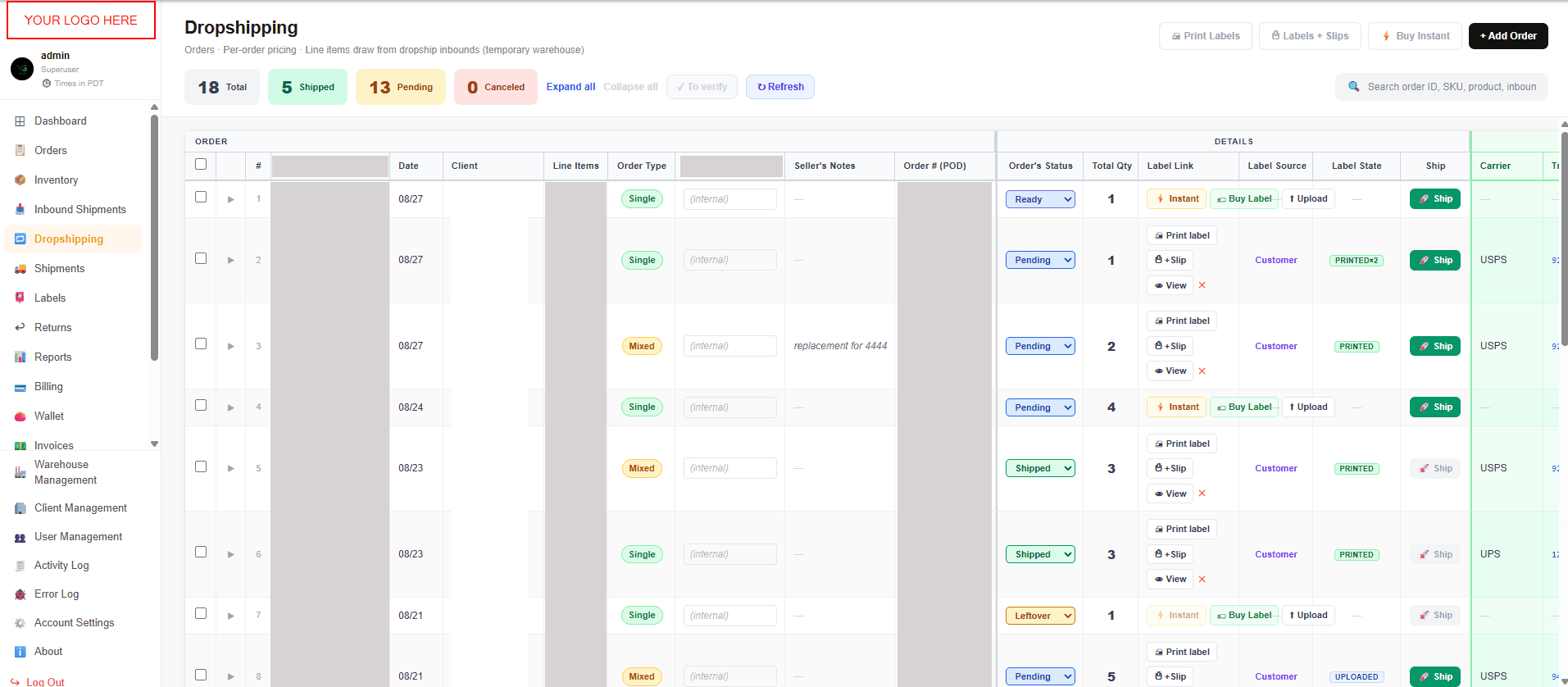
A dropship order is an operational path inside the same 3PL system — its own inbound pool, labels, state transitions and per‑order billing — visible next to the client’s stock orders, not bolted on from the ecommerce side.
03
Billing you can trace, line by line
Storage tiers, receiving, pick/pack, shipping, ad‑hoc services and a wallet ledger per client are in the core product, not add‑ons. Every invoice line opens to the inventory, order, receiving or shipping event that created it.
Who it’s built for
The 3PL whose owner is still the billing department.
You’ll recognize yourself: a handful of seller clients, one building, a small team, and month‑end that takes a weekend because the spreadsheet, the inbox and the WMS each know a different part of the story.
3–15 seller clients
Enough that inventory disputes and missed storage charges have started to cost real money.
Stock + vendor‑direct
You fulfill from shelf stock and also ship orders that never touch it. Both need to show up on one invoice.
DTC, FBA prep, multi‑channel
Clients on Shopify, Amazon, WooCommerce, Walmart. Receiving, prep, labels and per‑unit tracking are the daily work.
Outgrowing the spreadsheet
Spreadsheets, QuickBooks and a basic WMS got you here. Replace the fragile parts first — inventory accounting and billing.
Try it · the real rule, running in your browser
Press the buttons.It won’t let you break it.
Most WMS software stores one number per SKU and hopes. FloorStack stores five and the database refuses any write that breaks the equation — which is why your counts, your client’s portal and your invoice always agree.
SKU 4471‑BLK · Sample product · Seller 03
24 = 16 + 6 + 0 + 2
received = available + reserved + sold + unsellable
Dropship, native
Vendor‑direct orders, modeled where the work happens.
Most platforms treat dropship as an ecommerce‑side routing rule. In FloorStack a vendor‑direct order sits in the same client and order model as a stock order — with its own inbound, states, exceptions and billing — so the portal, the audit log and the invoice all agree on what happened.
Month end · drag the pallets
Their invoice. Ours.Same client, same month.
Industry benchmarks put only about a quarter of 3PLs billing through their WMS, and one in five billing fully by hand. Here, storage tiers, per‑order fees and postage pass‑through post to the client’s wallet as the work happens; the invoice is the ledger, priced.
Their invoice · the usual way
Assembled Friday night from three exports, a shared inbox and a memory of which pallets moved when. Uncaptured charges never make it on.
FloorStack invoice · INV‑0192 · Seller 03
The actual software, running a real warehouse.
Production screens, September 2026 · client details redacted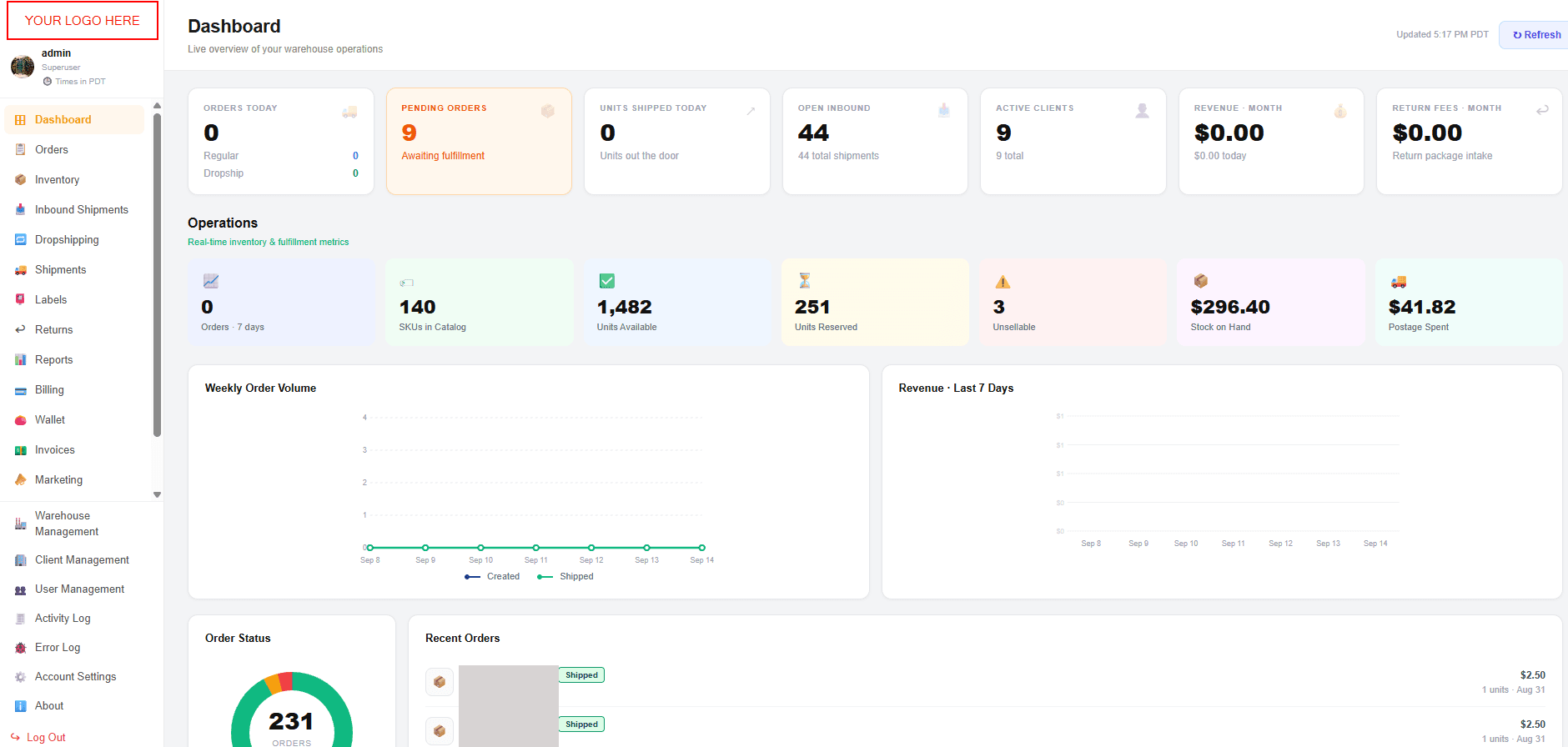
Two logins, one set of numbers
Your floor sees everything. Each seller sees only theirs.
Same database, two views. When a picker scans a unit out, the seller’s available count drops and their wallet is charged in the same transaction. Nobody reconciles anything at month end because nothing drifted.
Warehouse staff
Owner, ops lead, pickers — role‑based
Your seller clients
Portal login, scoped to their SKUs and money
Dashboard
- Today at a glance — orders in (regular vs dropship), pending, units shipped, open inbounds, revenue and return fees this month
- Operations strip — SKUs, units available, units reserved, unsellable, stock value on hand, postage spent
- Seven‑day trend — orders created vs shipped, revenue by day; order‑status breakdown
- Exceptions first — short receipts, label failures, unsellable spikes surface before anyone asks
- Audit log on every row — who changed what, when, from what to what
- Their inventory, all five counts — received, available, reserved, sold, unsellable, live
- Orders and tracking — place one, upload a CSV, watch it move from pending to shipped with the carrier link
- Inbound ETA — what they sent you, what arrived, what was short
- Low‑stock flags — on their own SKUs so they reorder before you run out
- No emails to you — for “how many do I have left?” — that is the point
Billing
- Rate card per client — storage tiers by pallet or bin, pick/pack, dropship handling, receiving per parcel, return fees
- Charges post as work happens — a label bought is a ledger line the same second, postage at cost
- Month‑end in one click — invoices generated from the ledger, every line linking back to the order or pallet‑day
- Wallet controls — pre‑fund thresholds, low‑balance holds, credits and adjustments with a reason on record
- Revenue by client — who is profitable, who is storage‑heavy, before the quarter ends
- Wallet balance, live — top up by card or transfer, see the running balance after every charge
- Every charge itemized — this label, this order, this pallet‑day; nothing called “misc”
- Storage tier and next threshold — they know what moving 12 pallets out would save
- Invoice history, PDF — downloadable, matching the ledger to the cent
- Fewer billing disputes — when both sides look at the same ledger, the argument is short
Warehouse staff
Owner, ops lead, pickers — role‑based
Dashboard
- Today at a glance — orders in (regular vs dropship), pending, units shipped, open inbounds, revenue and return fees this month
- Operations strip — SKUs, units available, units reserved, unsellable, stock value on hand, postage spent
- Seven‑day trend — orders created vs shipped, revenue by day; order‑status breakdown
- Exceptions first — short receipts, label failures, unsellable spikes surface before anyone asks
- Audit log on every row — who changed what, when, from what to what
Billing
- Rate card per client — storage tiers by pallet or bin, pick/pack, dropship handling, receiving per parcel, return fees
- Charges post as work happens — a label bought is a ledger line the same second, postage at cost
- Month‑end in one click — invoices generated from the ledger, every line linking back to the order or pallet‑day
- Wallet controls — pre‑fund thresholds, low‑balance holds, credits and adjustments with a reason on record
- Revenue by client — who is profitable, who is storage‑heavy, before the quarter ends
Your seller clients
Portal login, scoped to their SKUs and money
Dashboard
- Their inventory, all five counts — received, available, reserved, sold, unsellable, live
- Orders and tracking — place one, upload a CSV, watch it move from pending to shipped with the carrier link
- Inbound ETA — what they sent you, what arrived, what was short
- Low‑stock flags — on their own SKUs so they reorder before you run out
- No emails to you — for “how many do I have left?” — that is the point
Billing
- Wallet balance, live — top up by card or transfer, see the running balance after every charge
- Every charge itemized — this label, this order, this pallet‑day; nothing called “misc”
- Storage tier and next threshold — they know what moving 12 pallets out would save
- Invoice history, PDF — downloadable, matching the ledger to the cent
- Fewer billing disputes — when both sides look at the same ledger, the argument is short
Straight comparison
One price, published. Most of the market quotes.
Good products exist at every price here. We priced FloorStack for a 3PL that is still small enough to answer its own phone — and we don’t charge per user or per client, because that punishes you for winning customers.
| Platform | Entry price | Pricing | Per‑user / per‑client fees |
|---|---|---|---|
| FloorStack | from $199/mo | Published | None |
| CartonCloud | ~$499–599/mo | Quote, usage‑based | Usage‑driven |
| Extensiv 3PL Warehouse Manager | ~$599/mo cited | Quote; billing modular | Varies |
| Packem | ~$750–1,800/mo | Inconsistent across sources | — |
| Packiyo | ~$949/mo | Tailored; 5 users incl. | Per user |
| ShipHero | ~$1,995–2,145/mo | Quote; ~$2,000 onboarding | — |
The 20‑minute walkthrough
Not a sandbox. A realistic client account, end to end.
Six things you will see happen, in order, with the audit log open the whole time. Bring your own month of invoices and we run the same path on your numbers.
Book the walkthrough72%
of shippers choose a 3PL on service over price. The software behind you should make you more accurate and more responsive — not more automated on paper. Inbound Logistics, 2025
34%
of failed 3PL relationships end over poor customer service. A portal that answers “how many do I have left?” before the client asks is a retention tool. Inbound Logistics, 2025
<1h
Our published support response, business hours Pacific, from the people who built it. Ordinary operational questions included; custom implementation quoted, never sprung on you.
What’s in the warehouse. What shipped.What a client owes — and why.
Or leave your details and we will come to you.